Block paving gives you more design choice than any other hard driveway surface. The colour, the pattern, the edging, the border detail — all of it can be varied, combined, and adjusted to suit the property. That flexibility is one of the main reasons people choose block paving over tarmac when budget allows.
It also means there’s more to think about before you commit. The wrong colour on a red brick property, or a pattern that doesn’t suit the scale of the space, can end up looking worse than a plain tarmac finish. Getting it right isn’t complicated, but it helps to see the options clearly.
This guide covers the main block paving patterns, colour choices, and design approaches that work in practice on UK homes. For pricing and installation detail, the block paving driveways service page has the full information.
Patterns: The Foundation of Block Paving Design
The pattern you choose affects how the finished driveway looks and how structurally it performs under traffic. These aren’t always the same thing, so it’s worth knowing the difference.
Herringbone
The most popular pattern for driveways, and with good reason. Herringbone is laid at 45 degrees to the direction of traffic, which gives the blocks a natural interlocking resistance to moving under load. It’s the strongest structural choice for a driveway that will see regular vehicle traffic.
Visually, herringbone is dynamic and detailed. On a wide driveway it creates a strong sense of direction and movement. On a narrower single driveway it can feel busy — but that’s manageable with the right block size and colour.
It’s available in 45-degree and 90-degree variants. The 45-degree version is more visually active; 90-degree herringbone gives a slightly calmer, more formal result.
Stretcher Bond (Running Bond)
Stretcher bond is the pattern of a standard brick wall: blocks laid in rows with each block offset by half a block-length from the one below. It’s simpler than herringbone and creates a clean, linear result.
It’s less structurally strong than herringbone under vehicle traffic because the blocks don’t interlock in two directions. For driveways, some contractors reinforce the edging to compensate. For paths and pedestrian areas, it’s perfectly sufficient.
Visually, stretcher bond suits contemporary properties and smaller spaces where herringbone would look overly complex.
Basketweave
Pairs of blocks laid alternately horizontal and vertical to create a woven appearance. It’s the most traditional-looking of the standard patterns and works well on period and older properties. Less common on modern driveways, but in the right setting it’s a strong choice.
Colour: Getting It Right for Your Property
Block paving comes in a wide colour range. The main residential choices are charcoal, buff, brindle, red, and natural/grey. Within each of those families there are several shades available depending on the manufacturer.
Charcoal is the most popular contemporary choice. It works with grey and anthracite window frames, modern render finishes, and any property with a cool or dark exterior palette. It photographs well and ages well.
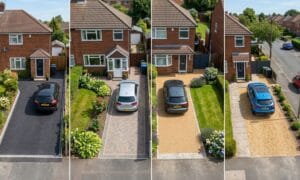
Buff is a warm neutral. It suits sandstone, light brick, cream render, and contemporary properties with warmer finishes. It’s also a popular choice for front gardens where the colour needs to sit comfortably alongside planting and lawn.
Brindle is a mix of reds, browns, and oranges. It’s the classic choice for traditional red brick properties across the Midlands and North West, including most of Stoke-on-Trent, Stafford, and the surrounding areas. It reads as sympathetic to warm brick rather than contrasting with it.
Red is more specific than brindle — a single-tone red rather than a blend. It works well on some properties but can look stark if not balanced with contrasting edging.
Natural/grey suits stone-built properties, cottages, and rural settings where the aim is to blend rather than contrast.
Border and Edging Design
The border is where block paving design gets interesting. A contrasting border frame around the main driveway surface adds definition and lifts the overall result considerably.
Common approaches:
Single contrasting border: one row of blocks in a different colour around the perimeter. Charcoal blocks with a buff border, or buff blocks with a charcoal border, are both popular and work well.
Double border: two rows in contrasting colours, or a main colour with a narrow contrasting row and then a wider row in a third tone. More complex, suits larger driveways where there’s room to appreciate the layering.
Inset panel: a rectangle or square of blocks in a contrasting colour or pattern set into the centre of the driveway. Common on wider properties in the Westlands area of Newcastle-under-Lyme or the larger plots in Stafford, where there’s enough surface area to create a feature.
Granite sett border: a row of small granite setts in place of block edging. Adds texture contrast and suits period and traditional properties particularly well.
Design Ideas by Property Type
Victorian and Edwardian terraces (Stoke-on-Trent, Stafford town centre): Brindle or red blocks in a basketweave or herringbone pattern with granite sett edging. Symmetry matters on terrace frontages — centre the pattern on the door line where possible.
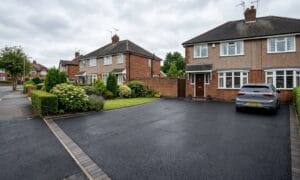
1930s semis: Buff or brindle herringbone with a contrasting border. The wider plot gives room for a double-width layout that looks properly finished rather than squeezed in.
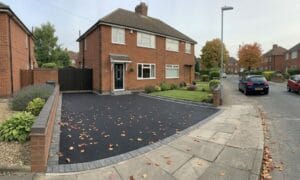
Post-war semis (across North Staffordshire): Charcoal herringbone with a buff border. Clean and contemporary without trying too hard.
Modern and new-build properties: Charcoal or anthracite in a large-format block (200 x 100 or bigger) with a granite sett or matching charcoal border. Keep the pattern simple — the size of the blocks does the visual work.
Detached and larger properties: Room for more complexity. A central feature panel, a sweeping circular turning area, or a mixed pattern with contrasting insets can all work well on a driveway with enough surface area to carry it.
Practical Considerations
Block size: Smaller blocks (100 x 65mm) suit traditional and smaller driveways. Larger blocks (200 x 100mm or 240 x 160mm) suit contemporary properties and wider driveways. Mixing sizes is possible but needs careful planning.
Permeable block paving: Worth considering for front driveways. Permeable systems allow water to drain through the surface and into the sub-base rather than running off to the drain. This can remove the need for planning permission in some cases and contributes to sustainable drainage.
Getting maintenance right: Block paving needs kiln-dried sand in the joints, topped up every few years as it washes out. Weed growth in the joints is the main ongoing issue. A sealant applied after laying slows this down. The block paving cleaning guide covers ongoing maintenance in detail.
For cost information, the block paving cost guide and the block paving Stoke-on-Trent guide are both worth reading before you get quotes.
What is the most popular block paving pattern for driveways?
Herringbone is the most widely used pattern for driveways. It’s the strongest structural choice because the interlocking 45-degree angle resists block movement under vehicle traffic, and it gives a visually dynamic finish that works well across a wide range of property types.
What colour block paving suits a red brick house?
Brindle is the traditional choice for red brick properties and works particularly well because the mix of reds, browns and oranges complements warm brick rather than contrasting with it. Red and buff are also options depending on the shade of the brick. Charcoal can work on red brick if you want a contemporary contrast.
How much does block paving cost in Staffordshire?
Maughan Construction price standard block paving at around £70 per square metre installed, including sub-base, edging, and jointing. A standard double driveway of 45 to 55 square metres would typically come in at £5,500 to £7,000 fully installed.
Can block paving be laid in any pattern?
The main structural patterns for driveways are herringbone, stretcher bond, and basketweave. Herringbone is recommended for vehicle traffic because of its structural strength. Other patterns can be used but may need additional edge restraint to compensate for reduced interlocking resistance.
How do I keep block paving looking good long-term?
Top up the kiln-dried sand in the joints every few years as it washes out. Clear weeds promptly before they establish in the joints. Pressure wash annually to remove algae and staining, and re-sand the joints afterwards. A sealant applied after laying slows weed growth and makes cleaning easier. Full guidance is in our block paving cleaning guide.