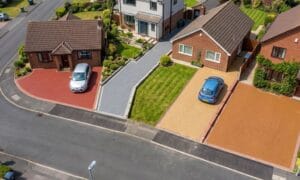
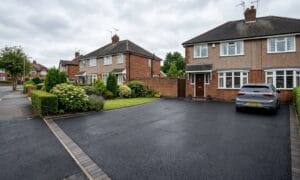
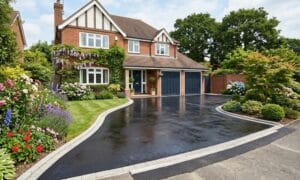
Most homeowners asking this question have already narrowed it down to two options and just want someone to give them a straight answer. The honest answer is that neither tarmac nor block paving is universally better. They suit different properties, different priorities, and different budgets. What follows is a proper side-by-side comparison so you can work out which one is the right fit for your driveway. Both surfaces are installed by Ted Maughan and the team at Maughan Construction across Stoke-on-Trent, Newcastle-under-Lyme, Stafford, Crewe, and the surrounding areas of Staffordshire and Cheshire, so this guide is written from 30 years of practical experience with both.
You can find full details on each service here: tarmac driveways and block paving driveways.
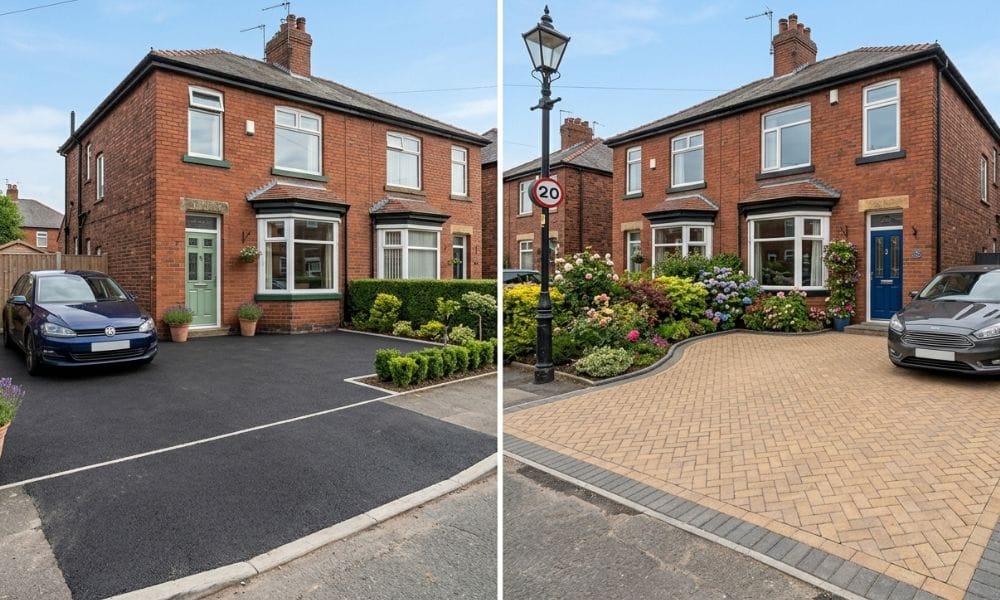
Cost: which is cheaper?
The per-square-metre price
This is where most comparisons get it wrong. Tarmac is often described as the cheaper option, but that depends entirely on what grade of tarmac you’re talking about. At the quality end of the market, tarmac costs around £100 per square metre installed. Block paving with Maughan Construction is priced at around £70 per square metre.
On a typical 40 square metre driveway, that’s £4,000 for tarmac versus £2,800 for block paving. Block paving is the more affordable option on a like-for-like basis when you’re comparing quality installation.
Lifetime cost
The calculation shifts a little when you look further ahead. Tarmac benefits from being resealed every five to seven years to maintain its appearance and surface integrity. Block paving needs less routine intervention but may need re-sanding of joints and occasional weed treatment over time. Neither is expensive to maintain, but tarmac does require more active upkeep if you want it looking its best at the 10-year mark.
Our guide to how much a tarmac driveway costs and our block paving cost guide break both down in more detail if you want the full picture on pricing.
Lifespan and durability
How long each surface lasts
A well-installed block paving driveway will typically last 20 to 30 years with basic maintenance. Tarmac, installed to a high standard with a proper sub-base, lasts around 15 to 20 years before it needs resurfacing. Both figures assume correct groundwork from the start. Shortcuts at the excavation and sub-base stage shorten the lifespan of either surface considerably.
Repairs when things go wrong
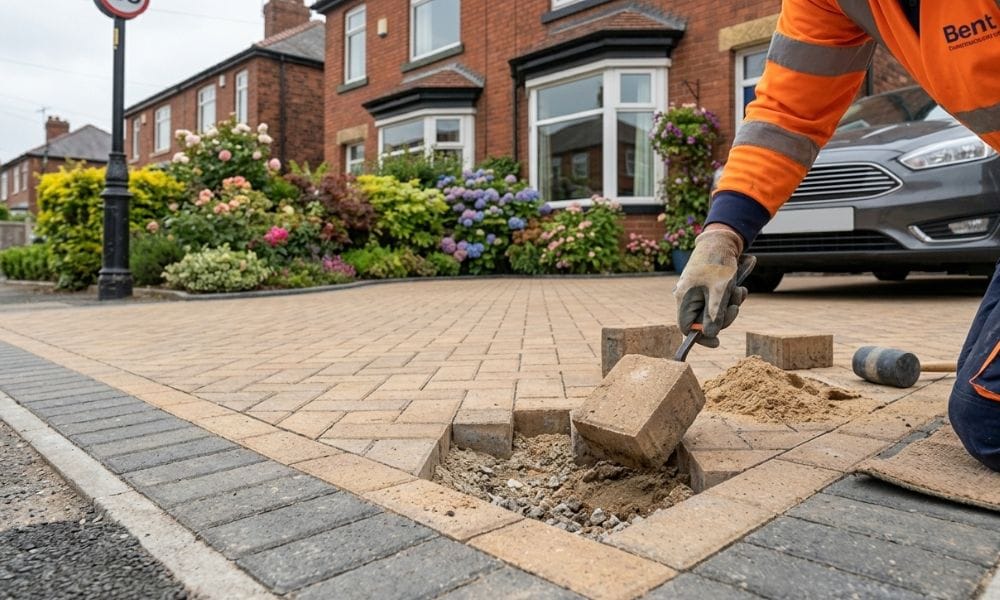
This is one of the clearest differences between the two. If a block paving driveway develops a problem, whether it’s a sunken area from a leak underground, a stained patch, or a cracked block, you can lift out the affected blocks and deal with the issue without touching the rest of the surface. The repaired area will look near-identical to the rest once fresh blocks and sand are in place.
Tarmac is harder to repair invisibly. Patching over a damaged area tends to show, especially as the patch and the surrounding surface age at different rates. A full resurfacing job every 15 to 20 years solves this, but it’s worth factoring in if longevity of appearance matters to you.
Appearance and design options
Tarmac
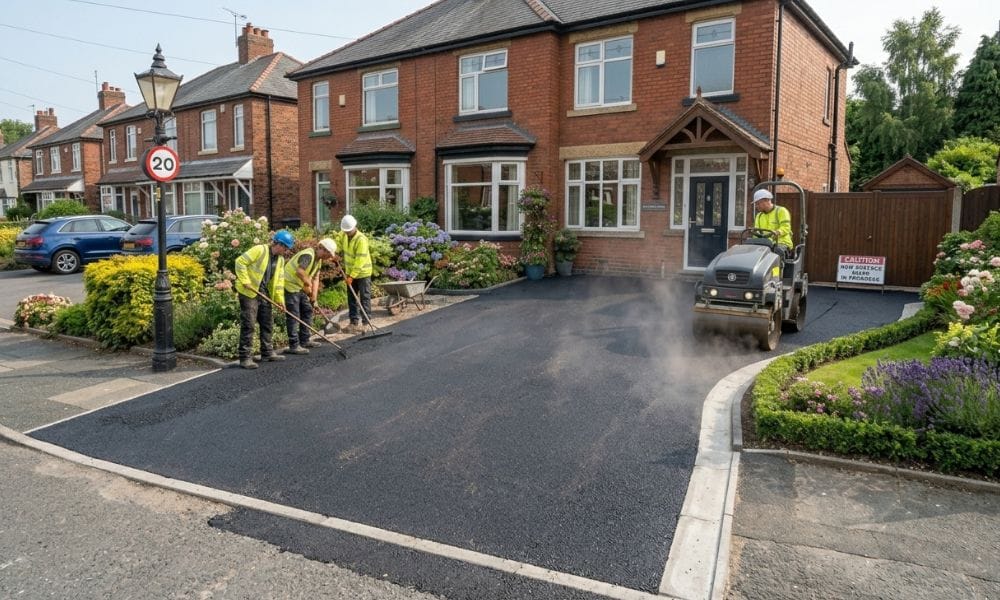
Tarmac gives a clean, uniform finish that suits a lot of properties well, particularly modern homes and those where a minimal, unfussy look is preferred. Standard tarmac is black, but coloured options are available and growing in popularity across Staffordshire. Red is the most common alternative, followed by buff and green.
The look is consistent and low-key, which some homeowners actively prefer. There are no patterns, no colour variation between sections, and nothing that can look mismatched over time. If you want a surface that requires no design decisions and just looks tidy, tarmac delivers that reliably.
Our posts on tarmac colour options and coloured tarmac driveway ideas cover the design possibilities in more detail.
Block paving
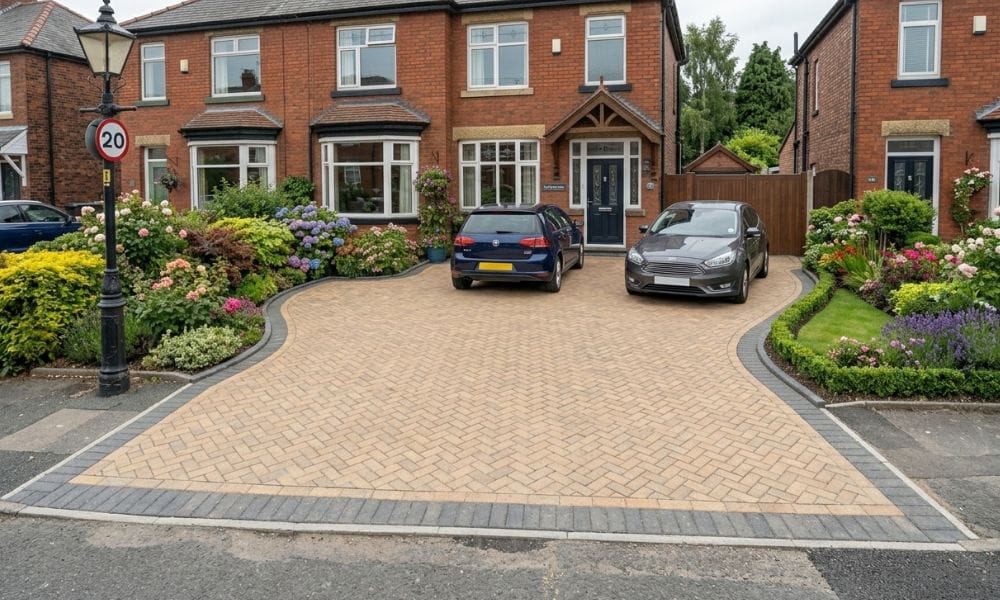
Block paving offers considerably more choice. Colour, block size, laying pattern, and border treatments can all be varied to create something specific to your property. Herringbone is the most structurally sound pattern for driveways that take regular vehicle traffic. Stretcher bond, basketweave, and linear patterns are popular for areas with lighter use or a more contemporary aesthetic.
The range of colours runs from traditional buff and charcoal through to russet, red, and silver. You can mix colours to create borders or contrasting panels, which works particularly well on larger driveways or properties with distinctive frontages. For homeowners who care about kerb appeal and want the driveway to complement the house rather than just exist in front of it, block paving gives you far more to work with.
Drainage and planning permission
How each surface handles water
Drainage is an increasingly important consideration for new driveways. Planning regulations require that new driveways over 5 square metres using non-permeable materials must drain water somewhere other than the public highway.
Block paving handles this more naturally. Water drains through the joints between blocks, which means permeable block paving can comply with drainage requirements without additional drainage infrastructure in most cases. This matters practically if you’re in an area with limited drainage options or a sloped site.
Tarmac is not permeable in its standard form, which means drainage needs to be directed away from the highway through a drainage channel, soakaway, or lawn border. This is straightforward in most cases, but it’s an extra element to consider and occasionally an extra cost. Permeable tarmac exists but is less commonly installed for residential driveways.
For a full breakdown of the planning rules, our post on planning permission for tarmac driveways covers the regulations in detail. Much of what it describes applies equally to block paving.
Installation time and disruption
Tarmac
Tarmac is the faster installation of the two. A standard driveway can typically be completed in one to two days. The surface cools quickly and can be driven on within 24 hours of laying. If you want minimal disruption and a fast turnaround, tarmac has a clear advantage here.
Block paving
Block paving takes longer, typically two to five days for a standard residential driveway. Blocks are laid by hand one at a time, and the jointing sand needs time to settle before the surface is fully ready. You can drive on it within 24 to 48 hours, but the process is more involved than tarmac from start to finish.
The extra time reflects the extra precision. Block paving requires consistent joint gaps, accurate cutting around edges and obstacles, and careful compaction at the jointing stage. An experienced team makes it look straightforward, but it’s a skilled job that takes longer for a reason.
Which is better for Stoke-on-Trent properties?
The housing stock here matters
Stoke-on-Trent has a specific character when it comes to housing. The majority of properties are Victorian and Edwardian terraces, inter-war semis, and post-war housing, particularly across Longton, Burslem, Tunstall, Fenton, and Hanley. These properties tend to have narrow frontages, often with a dropped kerb leading to a single car width.
Block paving works particularly well on these properties. The design options let you work with a smaller frontage in a way that looks considered rather than just functional. Charcoal or buff herringbone on a terrace in Longton looks far better than a flat tarmac run, and the individual block scale suits narrower driveways naturally.
That said, tarmac is a strong choice on larger detached properties where a sweeping, unbroken surface is the intended look, and on any property where the owner simply wants a reliable, low-decision surface that does its job without fuss.
Properties around Stafford and Crewe
In Stafford and across the Crewe area, where detached and larger semi-detached properties are more common, the choice opens up more. Larger driveways make block paving’s design options more impactful, and the per-square-metre price advantage of block paving over tarmac becomes more significant as the area grows.
The straightforward verdict
For design flexibility, repairability, and long-term value, block paving comes out ahead. For speed of installation, simplicity, and a clean uniform finish, tarmac is the stronger choice. Cost-wise, block paving is actually cheaper per square metre at the quality end of the market, which surprises most people who assume tarmac is always the budget option.
The best way to decide is to get quotes for both and see what works for your specific property and budget. Ted Maughan and the team at Maughan Construction install both surfaces to the same standard and will give you an honest recommendation based on your driveway rather than pushing you toward one option over the other.
Get a free quote in Stoke-on-Trent
Maughan Construction covers Stoke-on-Trent, Newcastle-under-Lyme, Stafford, Crewe, Congleton, Biddulph, and all surrounding areas of Staffordshire and Cheshire. Free quotes, no deposit required until the job is complete.
Is tarmac or block paving cheaper?
At the quality end of the market in Stoke-on-Trent, block paving costs around £70 per square metre while tarmac is priced at around £100 per square metre. On a typical 40 square metre driveway, block paving works out approximately £1,200 cheaper. Tarmac can be cheaper at the budget end, but the quality and lifespan reflect that. A fair comparison should be made between two contractors working to a similar standard.
Which lasts longer, tarmac or block paving?
Block paving lasts longer. A well-installed block paving driveway will typically last 20 to 30 years with basic maintenance. Tarmac installed to a high standard lasts around 15 to 20 years before needing resurfacing. Both figures depend heavily on the quality of groundwork at the installation stage. Individual blocks can also be replaced if damaged, which effectively extends the life of a block paving driveway indefinitely with minor repairs.
Is block paving harder to maintain than tarmac?
Neither surface requires significant ongoing maintenance. Block paving benefits from an occasional jet wash and re-sanding of joints every few years, and weed growth in the joints needs treating once or twice a year. Tarmac needs resealing every five to seven years to keep it looking its best and to protect the surface. Block paving requires slightly less routine intervention, though tarmac is arguably simpler to maintain overall given there are no joints to manage.
Which is better for drainage, tarmac or block paving?
Block paving handles drainage more naturally. Water drains through the joints between blocks, and permeable block paving can comply with drainage regulations without additional infrastructure in most cases. Standard tarmac is not permeable, so drainage must be directed away from the public highway through a channel, soakaway, or lawn border. For sites with limited drainage options, block paving is the easier choice from a regulatory standpoint.
How long does each surface take to install?
Tarmac is faster: most standard driveways are completed in one to two days and can be driven on within 24 hours. Block paving typically takes two to five days as blocks are laid by hand and joints need time to settle. Both surfaces can be driven on within 24 to 48 hours of completion, but tarmac’s overall installation process is quicker.
Which surface is better for a terrace or semi-detached property?
Block paving tends to work particularly well on the terraces and semis common across Stoke-on-Trent, Longton, Burslem, and Fenton. The design options suit narrower frontages and complement the character of Victorian and Edwardian housing more naturally than a flat tarmac run. Tarmac is a strong choice for larger detached properties where a simple, sweeping finish is preferred, or for any homeowner who wants a low-fuss surface with no design decisions involved.
Do Maughan Construction install both tarmac and block paving?
Yes. Maughan Construction installs both surfaces to the same high standard across Stoke-on-Trent, Newcastle-under-Lyme, Stafford, Crewe, Congleton, Biddulph, and the wider Staffordshire and Cheshire area. Ted Maughan and the team will give you an honest recommendation based on your property and budget rather than pushing you toward one option. Free quotes are available with no deposit required until the job is complete.